ASTANDARDFORTHEGREENQUARTER
The green standards in force regulate the building. The territory between buildings is regulated by nobody. This section is about fixing that.
The gap in green regulation is not that there are too few standards. There are enough of them, and they are decent. The gap is that the unit of assessment is everywhere the object — the building — while the quality of an environment is not produced by an object. What follows sets out what is already in force, exactly where the boundary of regulation runs, and what is proposed as its subject. The calculation method is described separately; this is about what it becomes as a norm.
What is already in force
The place to start is not an idea but an inventory of the field. The citation details of every act below were checked against the text of the document rather than taken from a summary: a programme that gets a standard's number wrong will not survive its first professional reading.
ГОСТ 35329-2026
in force since 01.07.2026Green standards for multi-apartment residential buildings: 58 criteria, 35 of them mandatory, with Bronze, Silver and Gold ratings. Interstate status; developed in the construction technical committee and superseding the national standard of 2022.
The anchor document and the point of reference. Interstate status means a territorial layer built on top of it can also be interstate rather than merely national.
ГОСТ Р 70346-2022
in force since 2022The predecessor: the national green standard for multi-apartment housing. 81 criteria — 37 mandatory and 44 voluntary — across ten categories, 163 points maximum.
The history of the criteria and their weights. Comparing the two editions shows which requirements the industry judged unworkable on the way to interstate status, and which it kept.
ГОСТ Р 71392-2024
in force since 01.08.2024Green individual housing construction: 45 criteria across eight categories, on the same rating scale.
Proof of portability: the scale has already been carried successfully to a different type of object once. That is a direct precedent for carrying it to a territory.
ГОСТ Р 70387-2022
in force since 2022Comprehensive improvement and maintenance of urban territories: requirements for the structure of a municipality's improvement rules and the processes of drafting and updating them.
The only document at territorial level — and it is procedural. It regulates how a municipality writes its rules, not what result it must achieve. That is precisely the boundary beyond which nothing exists.
ГОСТ Р 71332-2024
in force since 2024Vertical greening — a continuation of the line of standards that began with green roofs.
It shows a settled habit of the industry: individual techniques are regulated before the system they are supposed to add up to.
ПП РФ № 1587
in force since 21.09.2021Criteria for sustainable, including green, development projects — the national taxonomy. “Construction of green buildings” appears as a criterion in its own right.
The bridge to money: meeting the taxonomy opens green financing instruments. Adding a territorial criterion there is a separate and possibly faster task than a new standard.
п. 21 ст. 381 НК РФ
in force since —Property tax relief for buildings of a high energy efficiency class.
The one financial incentive in this field that works today. It shows the form in which a territorial indicator could acquire economic weight.
Economic estimates — the construction cost premium and payback periods — are left out of this reading: the available figures come from trade press rather than from a methodology, and until we compute our own they are not used in the programme's documents.
Where the boundary runs
On the left, what already carries measurable requirements and a rating. On the right, what no document in force sets any requirement for. The split falls exactly along the edge of the object.
Regulated
The multi-apartment building — 58 criteria, mandatory and voluntary, on a three-step rating.
The individual house — 45 criteria across eight categories.
Individual greening techniques: roofs and vertical structures.
The energy efficiency class of a building, with a route to tax relief.
The procedure by which a municipality drafts its improvement rules.
Not regulated
The quarter and the residential district as a unit of green assessment.
Connectivity of green areas: where the framework is severed by an arterial road, railway tracks or a fence.
Access to nature measured along the street network rather than as a straight line on the map.
The thermal regime of a block and its canopy cover as verifiable quantities.
Confirmation of the result achieved, in use, after one year and after three.
A building can be awarded Gold while standing in a block without a single tree and with no walkable route to a park. The reverse holds too: a block with an excellent green framework is made of buildings without a single certificate. While the unit of assessment remains the building, both cases are equally invisible to the regulator.
The second gap: the certificate stops at commissioning
The rating is awarded on the design documents and confirmed when the building is commissioned. What happens to it three years later is checked by nobody and by nothing. An indicator nobody re-measures degrades — that is not a hypothesis but an observable property of any reporting system: the moment measurement stops, the report begins describing not the object but the intentions of whoever is reporting.
A ready answer exists and requires no new procedure. An energy efficiency class is awarded on the results of a survey — on fact, not on design. The same principle, a repeat measurement by the same method and in the same season, carries directly over to territorial indicators.
What the standard would cover
The proposal is a standard for a territorial unit — a quarter or a residential group — on a scale compatible with the rating of the building standard in force. Object and territory have to read in one coordinate system; otherwise a developer ends up with two incomparable documents and quite reasonably treats the second as surplus.
The condition without which the standard will not clear a technical committee: everything it requires to be measured must be measurable independently of whoever is being measured. A criterion computed by the developer about the developer is dismissed by the first question asked — and rightly so.
Computable from open data
The share of residents within a 300-metre walk of a green area — along the street network, not as a straight line on the map.
Framework connectivity: where green areas are joined by a walkable route and where they are severed.
Canopy cover and land surface temperature — from satellite imagery, always with the acquisition date.
Barriers: railway tracks, arterial roads, industrial sites.
Requires the data holder
Species composition, age and condition of plantings — available only from a municipal inventory.
Which body holds each plot on its balance sheet, and the actual cost of maintaining it.
Stormwater drainage: routes, discharge points and stretches that overflow.
Comprehensive redevelopment plans not yet released publicly.
The split survives into the text of the standard itself. Criteria in the left column become mandatory at once — anyone can re-check them from the same sources. Criteria on the right stay in the voluntary part until access to the data is secured in regulation: otherwise the standard would be unworkable in exactly those municipalities that never ran an inventory, and that would not be their fault.
Doesn't this already exist abroad?
The objection comes up before any other, so it is answered first. Territorial schemes abroad do exist — and reading how they are built works for the proposal rather than against it.
BREEAM Communities
The British scheme for assessing sustainability in masterplanning. Five categories — governance, social and economic wellbeing, resources and energy, land use and ecology, transport and movement — some forty criteria in all, on a scale from Pass to Outstanding.
Masterplanning of new communities and regeneration projects. The assessment is carried out by a licensed assessor engaged by the client.
LEED for Cities and Communities
The American scheme, split in two: Cities for existing municipalities with a governing body, Communities for new developments at the planning and design stage. Version 5 went through public comment during 2026.
Either a whole city or a new project. The existing built block as a unit of assessment falls between the two.
DGNB
The German system for districts. Alongside the established scheme for new development, a separate one for existing districts arrived in July 2026: fifteen criteria, the heaviest weight on climate and energy, trialled on seven pilot projects.
The first of the three to reach the existing district — and it did so only just, in 2026.
What follows from this
First, the claim that the West settled this long ago is factually wrong: international practice reached the existing district in 2026, at the same time as we did. Second, and more importantly, the German colleagues named on seven pilots exactly the obstacles set out in the right-hand column above — heterogeneous ownership, gaps in the data, and the sheer variation in the condition of the stock. A diagnosis arrived at independently and matching ours is an argument, not a coincidence.
The decisive difference, though, is not in the criteria but in the class of instrument. All three schemes are voluntary market certification: the assessment is made by an assessor the client engages, and the result exists exactly insofar as the client paid for it. What is proposed here is a norm whose mandatory part is computed by an outsider from open data — with no assessor, no contract and nobody's permission.
Three routes
The routes run in parallel and feed one another: the academic one lends legitimacy to the normative one, the normative one gives the legislative one a subject, and the legislative one returns practical significance to the academic one.
Academic
A dissertation and publications in peer-reviewed journals. The slowest route and the most durable: it is the only one that does not depend on a change in a committee's membership or an agency's priorities.
Years. Publications come early; the defence comes after everything else.
Normative
An organisational standard first — it makes the method legally applicable on the pilot straight away and doubles as a draft of the future national document. Then a proposal into the national standardisation programme through the relevant technical committee.
Organisational standard, about a year. National standard, two to three years from inclusion in the programme.
Legislative
The most visible and the most hazardous. It is worth entering only with a pilot already computed: without numbers the discussion collapses into an exchange of declarations, which is not won by whoever happens to be right.
First presentation after the pilot. Beyond that, outside the programme's control.
The legislative route deserves plain speaking, so as not to raise false expectations. A research organisation is not empowered to introduce legislation: bills are introduced by deputies, parliamentary factions, the government and regional legislatures. The programme's job is to prepare the concept, the case and the text so that they can be picked up and introduced. Beyond that, amending secondary legislation — adding a territorial criterion to the sustainable development taxonomy, for instance — can deliver an effect sooner and more cheaply than a new law.
What the programme does not do
Listed here rather than in a footnote: a programme without stated limits reads as a promise, and a promise cannot be checked.
It does not publish a composite score before the data. A figure of the form “this block scores so many out of a hundred” rests on hand-picked weights and is dismissed by the first question about where it came from. Such a score comes last, after the pilot.
It does not widen its subject. The topic attracts transport, waste, carbon footprint and social infrastructure; every addition pushes the result back a year. The subject is fixed: the green framework of a block and its verifiable characteristics.
It does not replace the standards in force or compete with them. The territorial level is built on top of the object level, not instead of it.
It does not promise deadlines it does not control. The development cycle of a national standard and the cycle of a dissertation defence both lie beyond the horizon of any working plan, and pretending otherwise builds failure into the very first presentation.
Why this matters
A green standard for the building already works, and that is a good thing. But nobody lives in a building — they live in a block: they step out of the entrance and either reach the forest or run into an arterial road. That part of their life is described by no regulatory document today, which is exactly why it is not designed, not financed and not checked.
While the unit of green assessment remains the building, the quality of the space between buildings will not improve by a single certificate. The programme's task is to make the block a subject of regulation, and its characteristics quantities an outsider can re-measure.
Explanatory note for the standardisation proposal
A draft of the document submitted with a proposal to include the topic in the national standardisation programme: the object of standardisation, the justification, links to the standards in force, and a review of foreign practice. The section on economic effect is deliberately left blank — the data required is not openly available, and the note states which data. Eight pages, in Russian.
The territory no one regulates
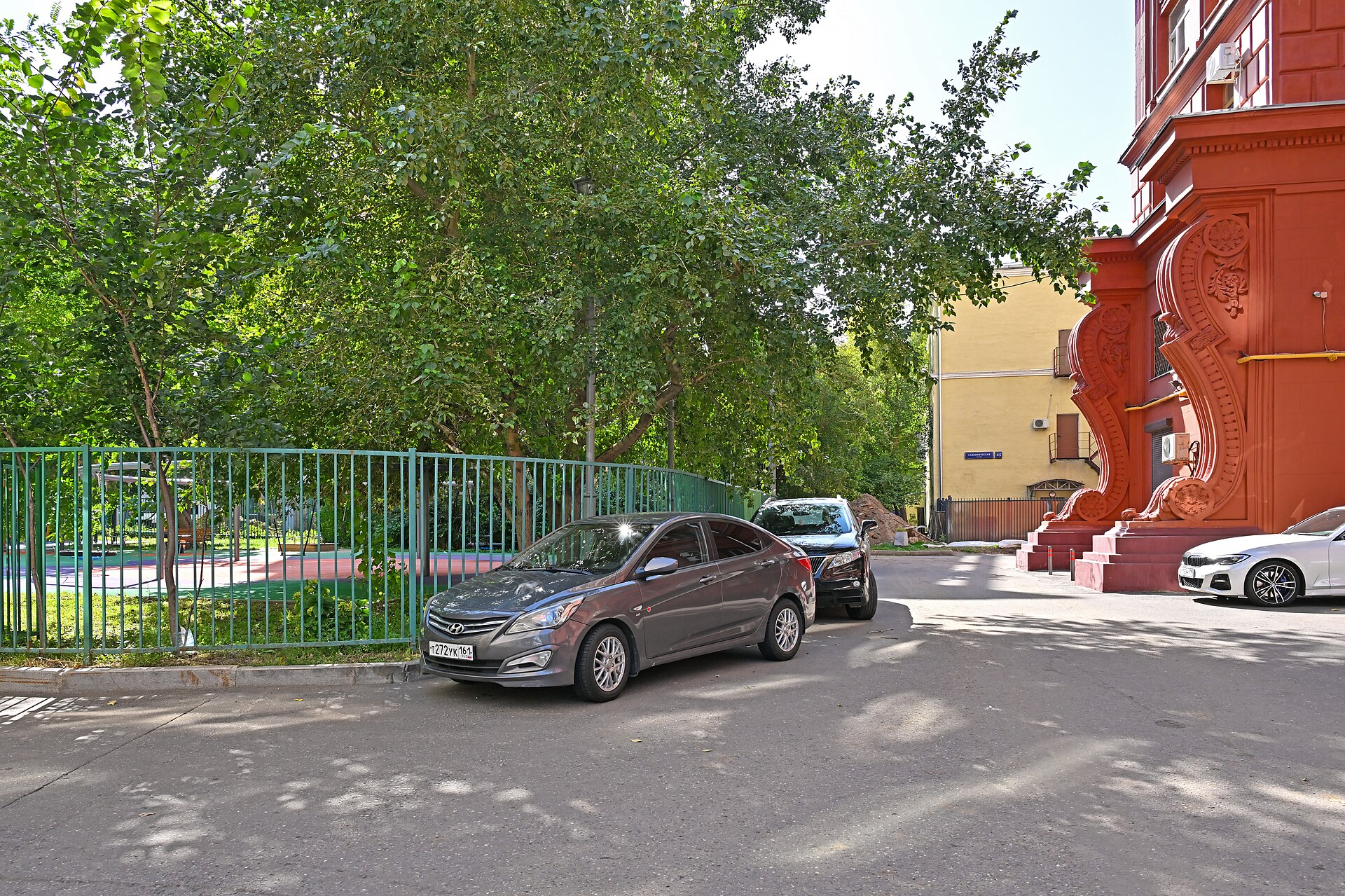
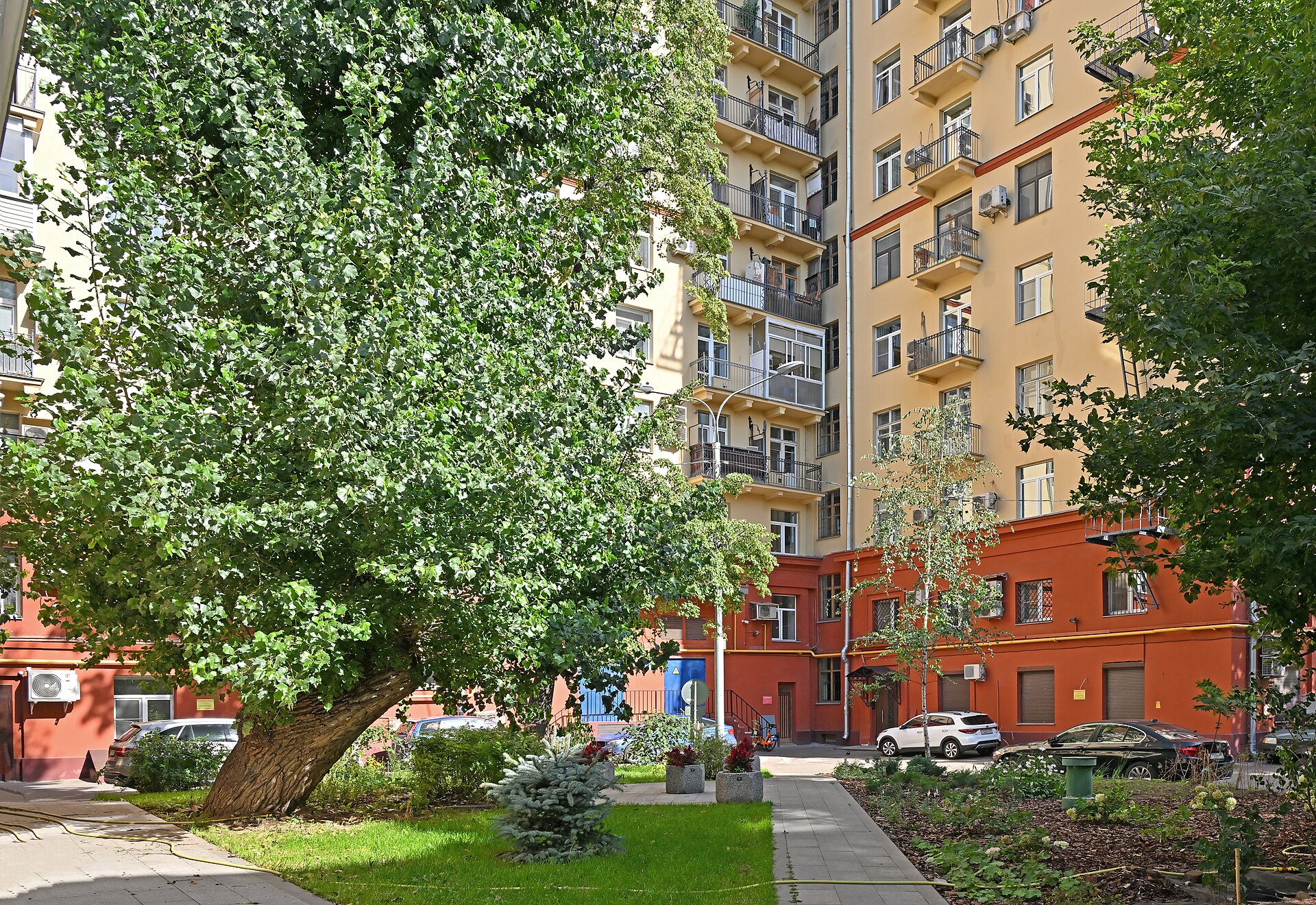
The courtyard of a residential building. The building behind the photographer is governed by a standard: heat, light, energy performance. What lies in front of it is governed by no one — not the number of trees, not accessibility, not whether any of it will still be green in three years.
1 / 2Юрий Д.К.CC BY 4.0