NORILSK
A limit case for the method
If the green-framework method and the infrastructure map work here, they work anywhere. Norilsk is the largest industrial hub of the Arctic: permafrost, wind, polar night, and a city where everything is shipped in. We tested both the method and our own data on it. Below is what we found, including what argues against us.
What it looks like
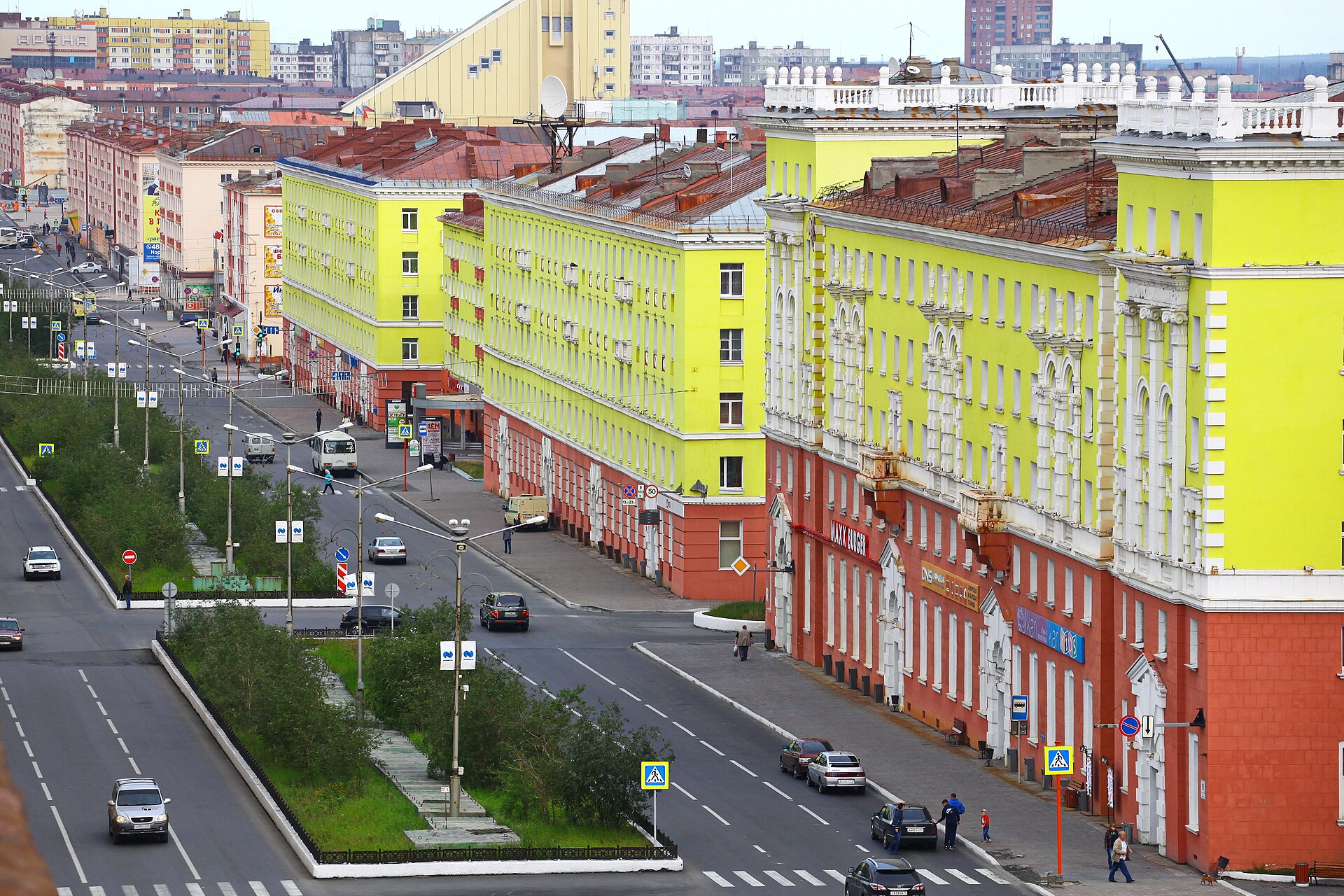
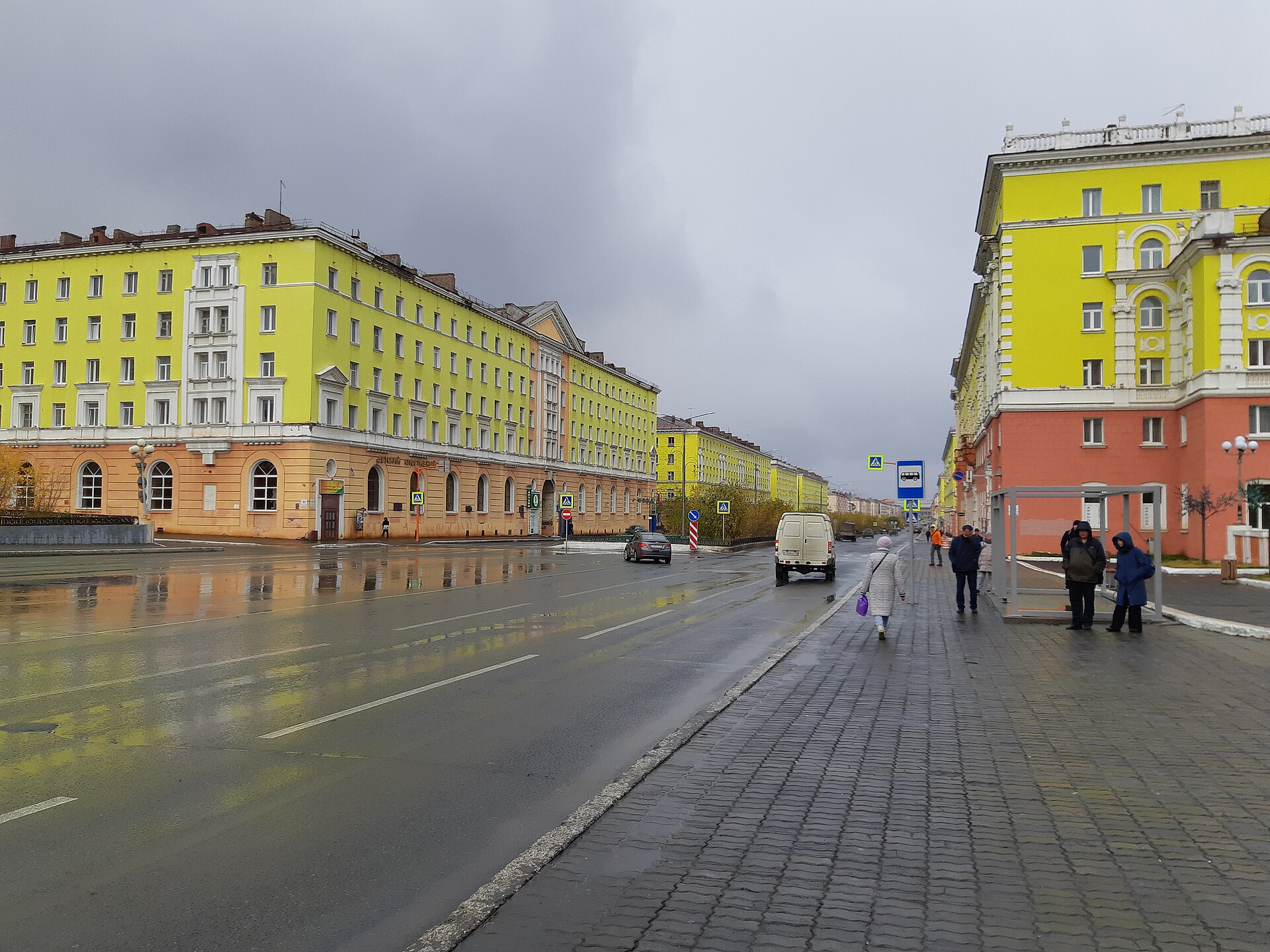
Norilsk: continuous development in the middle of tundra. The city was built where there is neither forest nor ground able to hold a foundation the ordinary way.
1 / 5Пихтарь Виктор ДмитриевичCC BY-SA 4.0
Why the dome was never built
Domed schemes for the North were developed in earnest — down to a settlement for four thousand people shaped as a single ring building holding housing, schools and a winter garden under one roof. In the competition for Norilsk’s renovation to 2035 the dome returned, this time as a covered square under a membrane shell.
Failure to build is usually blamed on money. The reason runs deeper and it is an engineering one: a dome contradicts the very principle the city stands on.
Norilsk holds because the ground beneath it stays frozen. Piles are frozen into the permafrost and the buildings sit over a ventilated undercroft whose job is to carry the building’s heat away. The first Norilsk buildings became unusable within a few years precisely because this was not yet understood.
A dome does the opposite: it creates a warm zone beneath itself. Thawing ground, loss of pile bearing capacity, settlement. Add the snow load over a span of that size, the wind, the heating of an enormous volume of air and the evacuation of a covered city, and the dome stops being an underfunded dream. It stops making sense in this particular place.
What here is fact and what is reasoning
The conclusion that a dome is incompatible with permafrost is our reasoning, not a quotation we found. It rests on what is verified: the Norilsk school of construction is built on keeping the ground frozen, and its degradation is already causing failures. The building at 14 Moskovskaya was evacuated after its foundation moved; around 250 buildings in the centre are due for demolition; new ones go on deeper metal foundations. If a permafrost engineer shows the reasoning is wrong, we will rewrite it.
What is worth building instead of a dome
The right conclusion is not "no dome" but a change of scale: cover the block and the links between buildings, not the city. Each solution below is compatible with permafrost because none creates a warm zone under housing.
Covered warm links instead of a covered city
Passages between buildings: a small span, a manageable snow load, a local thermal loop that does not touch the ground under the housing. A person crosses winter without stepping into minus forty in the wind, and the permafrost under the buildings stays frozen.
A courtyard atrium under a light shell
Not a city — a block. Exactly the scale our standard programme calls unregulated today: the building is governed by a standard, the territory between buildings by no one. The Arctic makes that gap especially plain.
A winter garden as part of the dwelling
The biophilic method under extreme conditions. If greenery outdoors is impossible for nine months, the green framework moves inside. For Norilsk that is not decoration but a health question — and an indicator that can be counted the same way an outdoor one is.
Wind-shielding block geometry
Norilsk used it historically: buildings were placed to shield courtyards from the wind. But it was used as a device, not as a norm. There is no requirement, so compliance cannot be checked, so in new development the device rests on the designer’s goodwill.
Ground thermal stabilisation as a requirement
Today cooling devices are installed piecemeal and often only after a failure. Scientists say plainly that construction norms for permafrost need revision. The economics are obvious: evacuating a building costs more than stabilising the ground beneath it. This is a ready subject for the standardisation track.
The bridge: a question of reliability, not architecture
The bridge over the Norilskaya river is Talnakh’s only link to the city. Not the main one — the only one. Talnakh means the mines the whole combine rests on, and tens of thousands of residents.
The bridge is repaired on a multi-year cycle: in 2025 and again in 2026, the main stage running from 1 June to 18 September with reversible, signal-controlled traffic. The bridge over the Nalednaya river on the same road was reconstructed separately and opened in October 2024.
So the country’s largest Arctic industrial hub runs on a single reversible lane for three and a half months a year. The only link has no backup, and any failure of the bridge means not inconvenience but a halt to extraction. If one is looking for what was never built and ought to be, a second crossing of the Norilskaya outweighs any dome.
A measure of our own blindness
We checked what our own map knows about Norilsk. Within the city radius: 45 gas objects, 6 substations, 1 settlement. Six substations for a city powering one of the world’s largest metallurgical combines is obviously not reality — it is a measure of the emptiness in the data. There is no official open layer, and volunteer mapping barely covers the Arctic. We show that figure rather than hide it: if the map drew a plausible picture here, it could not be trusted anywhere.
Why this matters to the project
Until now the biophilic line has walked around extreme climates, and that is its weak point: a method that works only in the temperate belt cannot be offered as a national one. Norilsk tests three things at once — whether a green framework can be counted where greenery is impossible for nine months; whether a block can be regulated where the building already is; and whether the map sees what open data does not hold. The first two answers are encouraging, the third is negative, and it is recorded in the register of the state of the data.
Sources
A page about a real city must carry its sources. Every factual claim above is checkable against the links below; reasoning is marked as reasoning.
- Какими могли быть арктические города — Arzamas
- Северный полис будущего: концепция реновации Норильска до 2035 года
- Первые норильские постройки приходили в негодность за несколько лет
- «Нормы строительства на вечной мерзлоте пора пересмотреть»
- Вечная мерзлота: мониторинг зданий и сооружений — Норникель
- Ремонт моста через реку Норильскую, 2026
- Реверсивное движение через Норилку с 1 июня 2026
- Открытие движения по мосту через реку Наледную, октябрь 2024